
Introduction

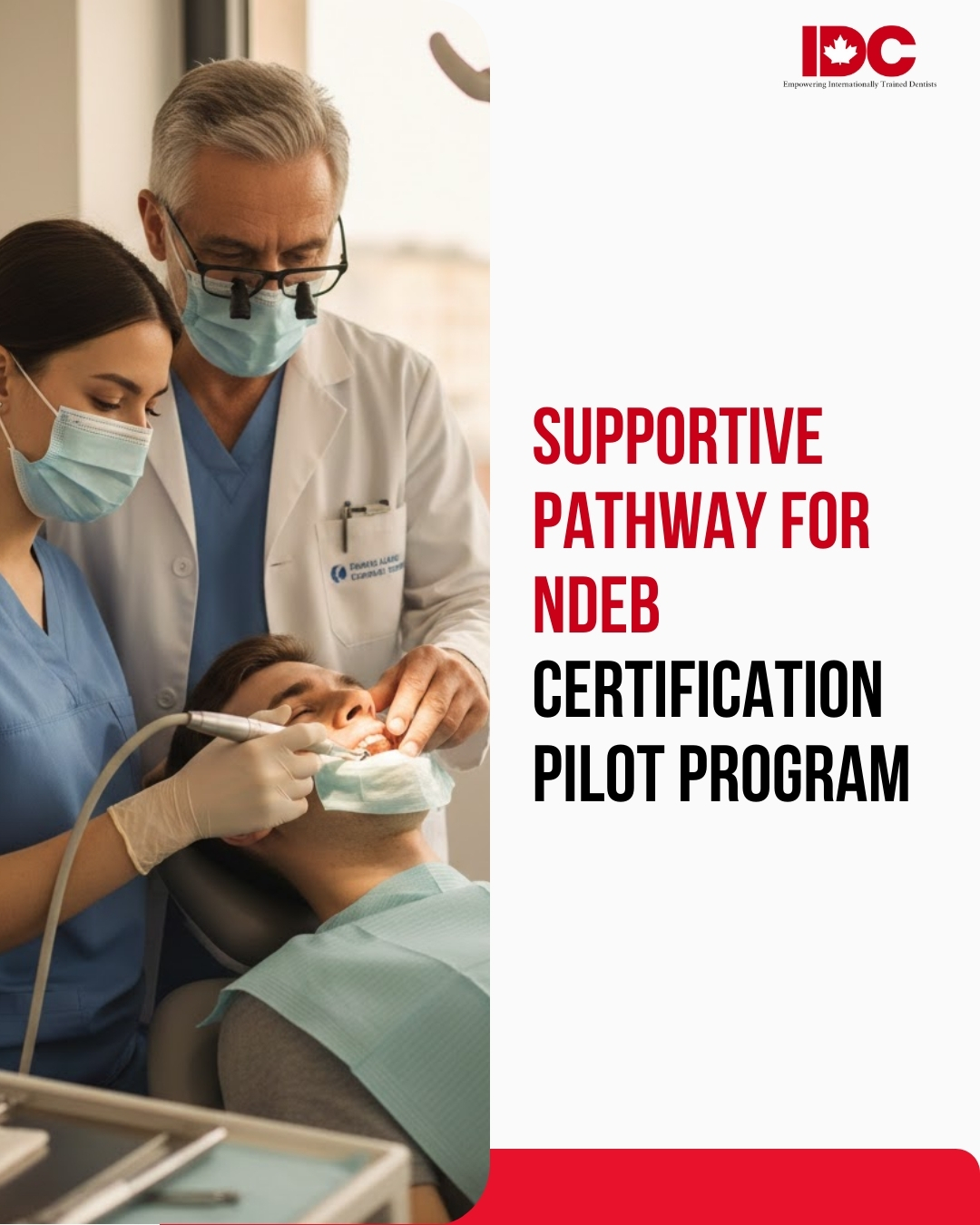
The Bridge Training to Dental Practice in Canada program (BTDPC) was designed and is under test to integrate Internationally Trained Dentists (ITDs) of non-accredited programs into the Canadian healthcare system. The program is a partnership between the Association of Canadian Faculties of Dentistry (ACFD), regulatory bodies, colleges, dental schools, and Employment and Social Development Canada (ESDC).
It is a competency-based program to validate clinical skills and knowledge of Internationally Trained Dentists (ITDs) of a non-accredited program.
BTDPC is for individuals following the equivalency process to obtain licensure as a general dentist in Canada who have passed the Assessment of Fundamental Knowledge (AFK) and Assessment of Clinical Judgement (ACJ) but have yet to pass the National Dental Examination of Clinical Competence (NDECC) examination.
This new program is currently in development and is undergoing pilot testing for two years at three locations:
- University of Alberta in Edmonton, Alberta, in English
- Dalhousie University in Halifax, Nova Scotia, in English
- l’Université Laval, Québec City, Québec, in French
Location for students will be determined during the application process. Duration – 8 Months
Details of the Program
In the BTDPC program, you will receive personalised training tailored to prepare you for a successful dental career in Canada. As a participant at a pilot site, you will be fully integrated into the dental school community, benefiting from hands-on learning and academic collaboration. Your schedule will be customised to target specific knowledge gaps, helping you build confidence as you progress toward licensure
The modules are thoughtfully designed for ITDs, combining rigorous academic standards with practical support. Students benefit from the exceptional quality of education offered by world-class universities, while enjoying the advantages of a close-knit faculty and student community. Our pilot sites rank among the best in Canada, and our faculty are internationally recognised for their research excellence and dedication to teaching.
Key facts
- Up to 8 months
- 1 intake of students per year
- 9 core modules
- 4 individualised modules (will vary)
- Full-time, weekdays classes
- In-person training
- Up to 10 students per site
Program Timeline
The project launched in 2024 and will continue through January 2028. During the first two years, all components of the program will be developed. The third and fourth years will focus on implementing, testing, and evaluating the pilot program through two full cycles across three participating dental school pilot sites. It is anticipated that the program will get accredited before the end of January 2026.
Program Content
Every student will undertake the following mandatory modules
- Patient management
- Professionalism and communication
- Patient assessment and treatment planning
- Radiology
- Periodontics
- Caries assessments and operative refresher
- Health promotion
- Oral surgery
- Clinical experiences
Based on the students pre-assessment, they will be assigned the following additional modules
- Endodontics
- Pediatric dentistry
- Prosthodontics
- Removable prosthodontics
- Fixed prosthodontics
Program Fees
Application fees – $500
Pre-entry assessment – $1,000
Program deposit – $3,000
Tuition – $30,000
Eligibility and Requirements
Eligibility
To be eligible to apply for the program, candidates must be
- Be a graduate of a minimum four-year recognised university dental program not accredited by CDAC.
- Be a Canadian citizen or a permanent resident of Canada on or before the application deadline
- Have passed, Assessment of Fundamental Knowledge (AFK), Assessment of Clinical Judgment (ACJ) within three years of the application deadline, these exams:
Requirements
- Personal Information matching NDEB profile.
- Credential verification and AFK, ACJ, examination result. NDECC result if attempted but not mandatory.
- Program location preference. Candidates need to submit only one application with the program location in their preferred order.
- Latest CV with references.
- Proof of citizenship/permanent residency in Canada.
- A 500-word statement enumerating our academic experience and how you enhanced your professional expertise.
- A 500-word statement describing your clinical work experience, specifically mentioning how long you provided clinical care to the patients after graduation, what kind of clinical care you provided, such as prosthodontics, restorative, periodontics, endodontics, and in what setting the care was provided.
- Contact details, including name, email, phone number, and relationship of three professional referees to verify your clinical work experience.
- There are two options to provide as evidence for English or French language proficiency. a. Proof of previous three or more years of study in English or French. B. Language exam including TOEFL-iBT or IELTS – Academic for English and Test d’évaluation de français (TEF) for French.
- Language assessment by completing a professional conversational language assessment (administered by the English Language School and the Faculty of St. Jean, University of Alberta). This will be after the application is submitted and completed during the assessment phase.
- Multiple Mini Interviews (MMI) – Interviews will be administered online through ACFD via the multiple mini-interviews (MMI) format. Kira Talent will be the service provider to administer the MMI interviews. Factors such as critical thinking, decision making, ability to work as a team, etc., will be evaluated in a series of discrete short interviews with independent evaluators. The minimum score is dependent on the average interview score and the standard deviation. As such, the minimum interview score will be reviewed and set yearly. Following the interview, all candidates who meet the minimum interview score are rank-ordered, and the top-ranked candidates are selected for an in-person assessment.
- Pre-Entry Assessment – This assessment is held in-person for six days at a pilot site. Based on your interview results, you may proceed to the pre-entry assessment. This will identify your areas of strength and weakness, relative to the following areas:
- Caries management and operative
- Periodontics
- Fixed and removable prosthodontics
- Endodontics
- Pediatric dentistry
- Oral surgery
Based on your results, this will determine your:
- Acceptance to the program
- Non-core modules during the program.
During the pre-entry assessment, it may be determined that this program is not a fit for you, and you may be recommended to apply for a three-year advanced placement or qualifying degree program.
- The application opens in January and May every year.